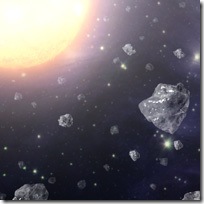
If I was Dr. Evil, looking for a way to become fabulously wealthy, I'd pay pretty close attention to this news. Scientists are increasingly convinced that cosmic dust clouds are full of tiny diamonds, and that now they've figured out a way to spot them.
Granted, we're not talking the Hope Diamond here. Or the Pink Panther. What's likely is that dust clouds in space are full of so-called nanodiamonds, about 25,000 times smaller than a grain of sand, far too small to see with the naked eye.
Scientists first understood these existed after studies of meteorites in the 1980s revealed the presence of these nano-scale diamonds, comprising as much as 3 percent of the space-stones' makeup. Based on these studies, they've calculated that a single gram of interstellar dust could contain as many as 10,000 trillion nanodiamonds.
Are you listening, Dr. Evil?
The question being, of course, why haven't we seen them before, even in the aggregate?
Researchers studying the question say this is likely because we simply haven't known how to look. We haven't known enough about infrared or electronic properties to spot them in telescope images before. But that may be changing.
Led by Ames Research Center astronomer Charles Bauschlicher, a team of researchers created a computer program simulating the conditions of nanodiamonds in outer space, deriving a likely infrared signature that would be given off when the tiny particles are struck by light from nearby stars.
This signature would be visible using the Spitzer space telescope's infrared spectrometer, they say. So an answer to the question of whether the heavens are really filled with glittering diamonds may soon be on its way.
Next up? Figuring out how the diamonds were created in the first place. Earth diamonds are created under extreme pressure and high temperatures, while these space diamonds seem to exist in clouds of molecular gas, at pressures billions of times lower, and temperatures near negative 400 degrees Fahrenheit.
VIA


 Nokia's new Morph concept phone would use nanotechnology to give it a flexible body with a transparent display that could be re-shaped depending on the user's needs, a far cry from today's solid and chunky devices. Even the electronics inside it would be transparent and flexible, so the whole phone may be twisted and stretched into bracelet shapes or tablet form, and nanotech cleverness means it would even clean itself. Developed in cooperation with Cambridge University, this glimpse of a distant future is now on display at the MoMA in New York.
 Who didn't like Super Soakers as a kid? You pump it a lot, it builds pressure, then it shoots liquid. In many ways, they were very similar to humans, which is why Lonnie Johnson, its inventor, is looking for ways to use harvest waste heat from humans to power a tiny Johnson system. The full name is the Johnson Thermoelectric Energy System, and it could be up to 60% efficient (standard car engines are only about 30% efficient) at the right temperature.
 IBM has successfully miniaturized the Cell processor that you know from Sony's PlayStation 3. Formerly built upon the 65nm scale, the new version will be based on the 45nm high-k process. What's this mean? Money, power and heat savings for Sony. And maybe a smaller or cheaper PS3 for you.
  We have a winner. This Cloverfield-sized mirror lens by Canon doesn't do zooming action, it's a flat 5200mm, which can shoot stuff 18 to 32 miles away. That's like from one end of Rosie O' Donnell's ass to the other. To focus this baby, it has telescopes bolted to the side.

 Sony Japan just announced a brand new satin silver version of the PS3. The standard 40GB machine will hit shelves in Japan on March 6th, but don't expect the color refresh love to be extended to the States anytime soon. Press release after the jump.
 The Maxablaster is a 38-million-candlepower flashlight that was made at home by (mad?) optics engineer Ralf Ottow. Replacing a commercial flashlight's bulb with a plasma-powered mercury arc bulb, the Maxablaster creates a highly focused beam of light with a high UV content not so different from a star.
  Remember the days of wallpaper illusions? Good. Because digitizing your child isn't the next Macbook feature. Steve Jobs hasn't lost control of his chief designer. The world is doomed (yet).
